Friday, December 3, 2010

2010 Biome Concept Mercedes-Benz Concept Cars

2010 Biome Concept Mercedes-Benz Concept Cars
The Mercedes-Benz BIOME is a natural technology hybrid, and forms part of our earth's ecosystem. It grows and thrives like the leaves on a tree" according to Hubert Lee, Head of the Mercedes-Benz Advanced Design Studios in Carlsbad.
Born out of the 2010 LA Auto Show’s Los Angeles Design Challenge, in which automotive designers are given free range to envision the future of transportation, the Biome is meant to blend seamlessly into the planet’s ecosystem. That means all components of the 2010 Biome Concept Mercedes-Benz Concept Cars are “grown” organically, and it emits pure oxygen and is fully compostable at the end of its service life.
2010 Biome Concept Mercedes-Benz Concept Cars
The basis for the Biome Concept is a vehicle that "grows in a completely organic environment from seeds sown in a nursery." Not only that, but it's powered by a combination of the sun and a chemical bond from an imaginary liquid dubbed BioNectar4534. It's all natural, all organic and all science fiction.
This year the competition had called for the creation of a vision of a safe and comfortable 2+2 compact car featuring good handling and a first-class design, and weighing only 1,000 lbs (around 454 kg/kerb weight).
The 2010 Biome Concept Mercedes-Benz Concept Cars symbiosis vehicle is made from an ultralight material called BioFibre and tips the scales at just 875.5 lbs (around 394 kg). This material is significantly lighter than metal or plastic, yet more robust than steel. BioFibre is grown from proprietary DNA in the Mercedes-Benz nursery, where it collects energy from the sun and stores it in a liquid chemical bond called BioNectar4534.
2010 Biome Concept Mercedes-Benz Concept Cars
The 2010 Biome Concept Mercedes-Benz Concept Cars is powered by BioNectar4534, which is stored in the BioFibre material of the chassis, interior, and wheels. In addition, Mercedes-Benz has developed a technology to equip trees with special receptors which can collect the excess solar energy and turn it into BioNectar4534. This creates a direct link with nature's energy sources and acts as an incentive to cover mobility energy requirements through more trees and at the same time maintain natural resources.
The Los Angeles Design Challenge is part of the Design Los Angeles conference, taking place from 17 to 18 November 2010 as part of the Los Angeles Auto Show.
2010 Biome Concept Mercedes-Benz Concept Cars

2011 Volkswagen Touareg Pictures

2011 Volkswagen Touareg Front Angle View2011 Volkswagen Touareg Front Angle View

2011 Volkswagen Touareg Pictures2011 Volkswagen Touareg Pictures

2011 Volkswagen Touareg Side View2011 Volkswagen Touareg Side View

2011 Volkswagen Touareg Car Interior2011 Volkswagen Touareg Car Interior

2011 Volkswagen Touareg Official Photos2011 Volkswagen Touareg Official Photos

2011 Volkswagen Touareg Rear Angle View2011 Volkswagen Touareg Rear Angle View

2011 Volkswagen Touareg Engine2011 Volkswagen Touareg Engine

2011 Volkswagen Touareg Rear Side View2011 Volkswagen Touareg Rear Side View

2011 Volkswagen Touareg Dashboard2011 Volkswagen Touareg Dashboard

2011 Volkswagen Touareg Pictures

2011 Volkswagen Touareg Front Angle View2011 Volkswagen Touareg Front Angle View

2011 Volkswagen Touareg Pictures2011 Volkswagen Touareg Pictures

2011 Volkswagen Touareg Side View2011 Volkswagen Touareg Side View

2011 Volkswagen Touareg Car Interior2011 Volkswagen Touareg Car Interior

2011 Volkswagen Touareg Official Photos2011 Volkswagen Touareg Official Photos

2011 Volkswagen Touareg Rear Angle View2011 Volkswagen Touareg Rear Angle View

2011 Volkswagen Touareg Engine2011 Volkswagen Touareg Engine

2011 Volkswagen Touareg Rear Side View2011 Volkswagen Touareg Rear Side View

2011 Volkswagen Touareg Dashboard2011 Volkswagen Touareg Dashboard

Opel Amphibian Sport Cars Icona Concept

Opel Amphibian Sport Cars Icona Concept
The Opel Icona Concept Cars is a design study of a futuristic amphibian electric vehicle with a sporty design and retracteable wheels. Keeping such scenario in mind, Swedish designer Juan Pablo Bernal P has designed a futuristic vehicle for the year 2050 that moves on both land and water with equal efficiency. Called the “OPEL ICONA,” the V-shaped commuter vehicle features an aerodynamic body to ensure minimal air resistance for better performance in all conditions. The V shaped dynamic design uses distinctive shapes, forms, patterns and proportions which are express the sporty and leisure-oriented character of the vehicle.
Running on natural sources of energy, the all-electric vehicle generates power from electric motors to allow a clean and green drive. The zero-emission car would not only allow a sustainable drive but also become a means of entertainment to create a special bond between the family members as well as society.
The Opel Amphibian Sport Cars Icona Concept is a hybrid car that can traverse land and sea is nothing new despite being the stuff of dreams at least half a century ago, but this concept cars takes things to a whole new level. It can transport an adult and a child. The Opel Icona project was developed in collaboration with Opel by Juan Pablo Bernal at the Umea Institute of Design, Sweden.
Opel Amphibian Sport Cars Icona Concept
Opel Amphibian Sport Cars Icona Concept features two modes of operation Viz. Land mode and Water Mode to run on ground and water respectively. When the vehicle runs on the ground the sail remains wrapped in the storage area; however, as soon as the occupant puts the vehicle on the water mode the sail retracts and the wheel arms rotate inboard to reduce drag, thus enabling this vehicle to cruise on water with the same speed and elegance.
Opel Amphibian Sport Cars Icona Concept
About the Designer:
Juan Pablo Bernal is Colombian Designer with a Bachelor in Transportation Design from Instituto Europeo di Design (2003-2006) and a MA Degree in Transportation Design from Umea institute of Design in Sweden.
Among his working experiences are internship at the GM Europe Design and at Scania, Sweden.
Opel Amphibian Sport Cars Icona Concept

Wednesday, December 1, 2010

eVaro Hybrid Sports Cars Concept (PHEV) With FVT

eVaro Hybrid Sports Cars Concept (PHEV) With FVT
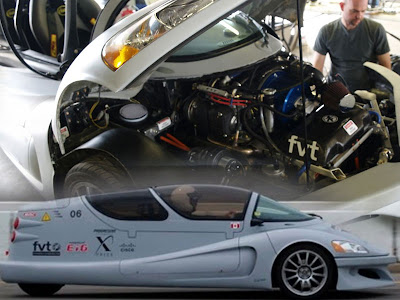
The new eVaro is a series hybrid, a fully functioning plug-in hybrid electric vehicle (PHEV) with an onboard gas generator, also referred to as an extended-range electric vehicle. While the eVaro is similar to the Chevrolet Volt, the only series hybrid currently confirmed for production (2010), the eVaro (as in “arrow”) has a number of features and performance criteria that will exceed the Volt. These include better aerodynamics (much lower drag coefficient), much less weight, much higher mile per gallon (electric) and a greater range.
The eVaro Hybrid Sports Cars Concept (PHEV) With FVT also compares extremely well with two vehicles from entrepreneurial companies that have received considerable media attention: the $109,000 Tesla and the Aptera. Both of these vehicles are battery electric vehicles (BEV) and, as such, are limited in their operating range because they have to be recharged. “FVT firmly believes that consumers will prefer the security of a series hybrid like the eVaro,” stated George Parker, president of FVT.
eVaro Hybrid Sports Cars Concept (PHEV) With FVT
The makers, Future Vehicle Technologies, say the car is more practical than the electric-only Tesla because it removes the “range anxiety” that comes with an all-electric car. The electric motor can be charged at home in three hours. They claim the car has three wheels instead of four to save fuel and make the car corner better.
Here are some coolest electric vehicles, designed and produced by companies of the United States, Canada and Japan. These electric cars are on display at the 2010 Electric Vehicles Trade Show in Vancouver, Canada, on Sept. 15, 2010.
eVaro Hybrid Sports Cars Concept (PHEV) With FVT
The eVaro is an extended-range electric vehicle that uses a carbon-fiber, Kevlar, and aluminum subframe. Parker claims the car has a 120-130 mile range on electric power, and a total range of 460 miles. The eVaro Hybrid Sports Cars Concept (PHEV) With FVT uses a 1.1-liter, four-cylinder gasoline engine, and it has a total weight of about 2,000 pounds.
The striking eVaro is surprisingly easy to enter, with the large canopy opening wide. There is room for a set of golf clubs to the left of the driver. There is an exterior trunk to the right of the driver and behind the passenger, giving the car more functionality than it might at first appear.
eVaro Hybrid Sports Cars Concept (PHEV) With FVT
The car is one of 43 finalists an entrant in the Automotive X-Prize, a US-based competition that will award $10 million in prizemoney to makers of a super fuel-efficient vehicle. To qualify, each entrant has to be able to achieve 100 miles to the gallon (2.3 litres per 100km), while providing acceptable performance.
FVT hopes to use the publicity surrounding the contest as a springboard to a initial production run of 3000 cars.
eVaro Hybrid Sports Cars Concept (PHEV) With FVT

2011 KTM Sport Cars X-Bow R Exclusive Class

KTM is developing another variant of its X-BOW model called the X-BOW R for 2011. The prototype of the model is featured in the photographs published here doing some testing. Pictured above is a prototype of the new X-Bow R taken at its first test outing at the Nurburgring circuit in Germany. The 2011 KTM Sport Cars X-Bow R Exclusive Class will be a sportier version of the current X-BOW from the boutique Austrian automaker (KTM is mainly a motorbike and bicycle maker) which has been available since 2008.
As far as streetable open-track cars go, the KTM X-Bow is in a very exclusive class, kept company primarily by the Ariel Atom and the Lotus 2-Eleven. But KTM is reportedly planning to up the ante with a pair of new models, including a race-bred R model and a more practical T model. The R model will likely be an evolution of the GT4 car.
The T model will up the comfort and practicality factor a bit for folks looking to get more double-duty out of the X-Bows, adding a windshield to divert air over the cockpit. That will no doubt be a welcome addition for those that would like to drive the car without wearing a helmet all the time. The X-Bow T will wait until 2012 to hit the streets.
After having been on the market for approximately two years now, the 2011 KTM Sport Cars X-Bow R Exclusive Class line-up will be supplemented with the introduction of the “R” model in the upcoming year. The engine for this even more powerful version comes again from Audi – but it will be exactly the same engine used among others in the actual Audi S3.
The X-BOW R will boast a 2.0-litre TFSI engine from the Audi S3, and this motor is good for 221kW of power. All of this will fit into the 790-kilogram body which boasts an upgraded suspension which is lowered, and better handling — thanks for a new engine mount setup. The two-seater will include a road-legal Sport package and a Race kit for the track only version.
At the moment KTM Cars is working intensively on the 2011 model of its super sports cars X-BOW. The first ever small series manufactured and street legal homologated car with a carbon fibre monocoque has been sold around 500 times since its launch in 2008. Around 50 X-BOW partners throughout Europe and currently ten importers globally look after sports cars enthusiasts all over the world in order to supply the only 790 kilogram light, 240 horsepower strong extreme athlete.